FC 27 TACTICS

Team tactics are responsible for making your team play the way you want.
FC 27 Team Tactics

Team Tactics for Ultimate Team


A player’s behavior is shaped by their OVR (physical and mental attributes), HyperMotion (movement traits), PlayStyles (on-the-ball skills), and Roles (off-the-ball abilities).

Unlike these individual factors, which affect only players, Team Tactics are applied to the entire team. This gives you greater control over crafting your strategy, sharing it with friends, and replicating real-world playing styles, while adding variety to each match.

How to edit a FC 27 Team Tactic?
  1. From the main Ultimate Team screen, press R1/RB three times to select [Club];
  2. Select [Squad];
  3. Press L3 to popup [Squad Actions];
  4. Select [Tactics];
  5. Select a tactic and press [Edit].
Along with Roles, creating a Team Tactic involves adjusting three groups:
  • Formation;
  • Build-Up Style;
  • Defensive Approach.
To be announced later
FC 27 Formations

Formations


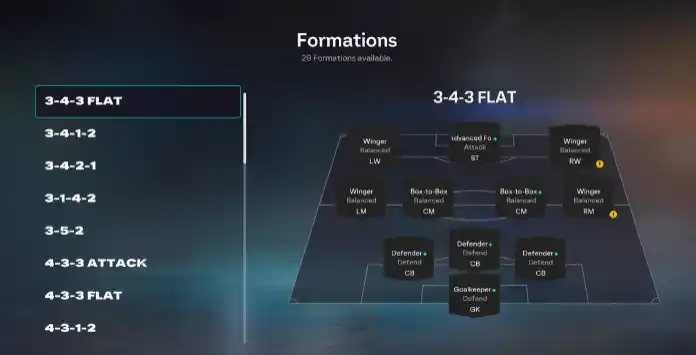
When creating a tactic, the first step is to choose a basis structure. Later, you can fine-tune individual player behavior with Roles and Focuses, but initially, you need to select one of the twenty-nine formations available in the game.

Formations remain essential in FC 27. While they no longer dictate your style of play as strictly as before, they are crucial for defining the positions and Roles available within your tactic.

The formation you select determines how your team defends and positions itself when out of possession, so choose carefully. Keep in mind that Roles continue to influence player behavior even within your base formation.
FC 27 Build-Up Style

Build-Up Style


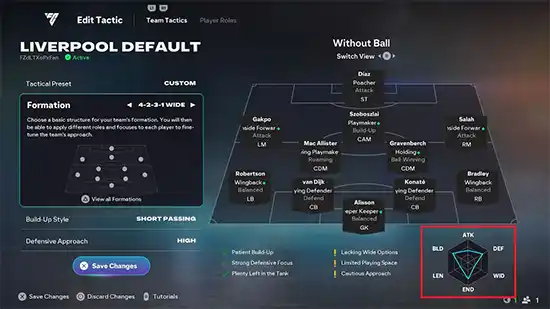
There are three Build-Up Styles that shape how your team advances the ball. They control the speed of transitions from defense to attack and the priority given to moving up the pitch, with Role Familiarity further influencing these movements.

These styles let your team either push forward quickly for fast attacks, perfect when an immediate goal is needed, or progress more deliberately with extra passes and possession focus, ideal under pressure.

In short, Build-Up Styles determine how efficiently your team moves from their own third to the opponent’s third.

Short Passing
Players will come short to support the ball carrier rather than make forward runs. This more cautious approach allows the team to maintain its defensive shape for longer during the transition.

Balanced
Players will vary between forward runs and coming short. The team’s transition to their in-possession shape will be steady rather than sudden.

Counter
This approach encourages players to get in behind the opposition’s defense as the team transitions quickly from defense to attack.
FC 27 Defensive Approach

Defensive Approach


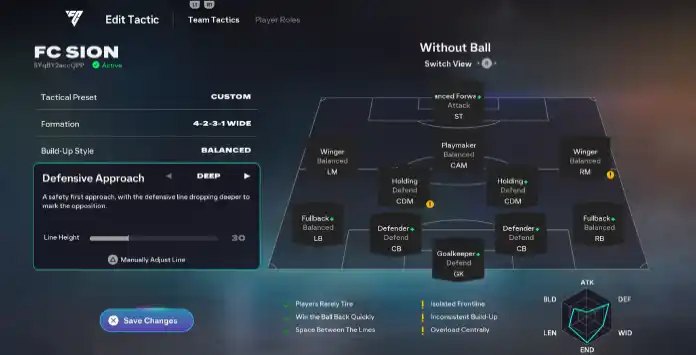
There are four Defensive Approaches, which combine Line Height/Depth, Pressure, and Run Tracking. Each one is directly connected to your team’s Line Height, which you can manually adjust between specific values. The higher the line, the higher up the field your defensive line sits.

Deep
A safety-first approach, with the defensive line dropping deeper to mark the opposition.

Balanced
This approach gives the defense flexibility on how deep they drop and which runs to track.

High
A riskier approach to defending, applying situational pressure, and adopting a high line that tends not to track opposition runs.

Aggressive
The most front-footed defensive approach, adopting a high line that focuses on applying the press immediately after losing possession and setting offside traps.
Tactical Presets

Tactical Presets


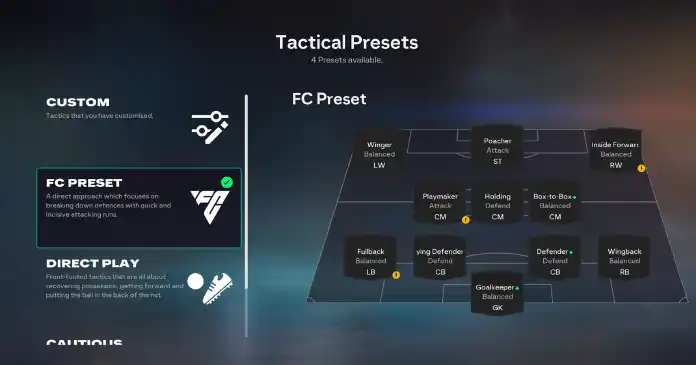
Tactical Presets are ready-made setups that mirror popular football strategies. They’re perfect for new players who aren’t familiar with tactics or prefer not to customize them. For experienced players, Presets serve as a solid starting point for creating tailored strategies.

Any modification to a Preset automatically changes it to Custom. Likewise, resetting a tactic restores it to its original state when you first opened the tactics screen.

The system also offers dynamic feedback, analyzing your team, tactics, and player Roles, and highlighting three strengths and three areas that could be improved.
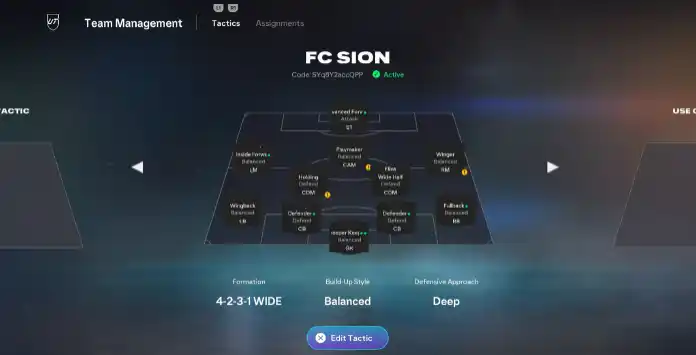
Custom Tactics

Custom Tactics


Custom Tactics let you control every aspect of your team’s strategy, making them ideal for experienced players who want to develop a unique playstyle or replicate specific approaches.

In Football Club, you can save up to five Custom Tactics. Each one can have its own name, formation, tactical settings, and Player Roles, with the lineup being the only element shared between them.

Within the Custom Tactics menu, you can create, import, edit, activate, and manage your tactics. You can also rename, duplicate (up to five), or delete them, but at least one tactic must always remain.
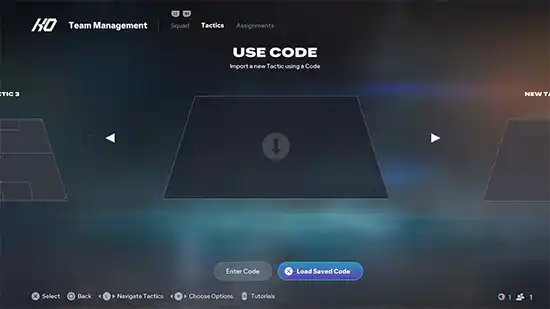
Code

Code


Every tactic in the game has a unique 11-digit code associated with it. This code system allows you to easily share your best tactics or import those from others when you need some inspiration.

This code includes the Formation, Build-Up Style, Defensive Awareness, Line Height, and the 11 Roles and Focuses, but does not include the tactic name.

The code is universal, working across any mode, console, or generation. To use it, simply select [Import Tactic] in the Custom Tactics menu and enter the shared code.

FC 26 tactics codes are compatible with FC 27 and will be converted to the FC27 format when applied.
Frequently Asked Questions
Team Tactics are essential for defining your team’s playing style. From formations to defensive strategies, they give you greater control over your approach and allow you to share your strategy with friends.
A Team Tactic is made up of three key components: the selected formation, the Build-Up Style, and the Defensive Approach. Together, they define how your team is organized on the pitch, both in attack and defense, allowing you to adapt your strategy to different match situations.
FC 27 features four Defensive Approaches (Deep, Balanced, High, and Aggressive), each combining Line Height/Depth, Pressure, and Run Tracking. Every Defensive Approach is linked to your team’s Line Height, which you can manually adjust within specific values. The higher the line, the further up the field your defensive line will sit.
Here’s how each approach affects your team:

  • Deep: A safety-first approach where the defensive line drops deeper to mark the opposition.
    • Line Height values: 1 – 30
    • Default Line Height: 25
    • Run Tracking: Line drops with runs
    • Pressure: None
  • Balanced: Provides flexibility, allowing the defense to adjust its depth and track runs as needed.
    • Line Height values: 31 – 60
    • Default Line Height: 50
    • Run Tracking: Line is flexible in tracking runs
    • Pressure: None
  • High: A riskier approach with a high defensive line, applying situational pressure but not tracking opposition runs closely.
    • Line Height values: 61 – 90
    • Default Line Height: 70
    • Run Tracking: Line rarely tracks runs
    • Pressure: Minimal
  • Aggressive: The most proactive defensive approach with a high line, focusing on immediate pressing after losing possession and setting offside traps.
    • Line Height values: 91 – 100
    • Default Line Height: 95
    • Run Tracking: Line never tracks runs; steps up to maintain the highest line possible
    • Pressure: On heavy touch
    • Extra stamina drain
In FC 27, three Build-Up Styles control how your team progresses up the pitch when in possession. These styles affect both the pace of your transition from defense to attack and the overall speed of forward movement.

  • Quick Attack
    Focuses on fast breaks and rapid movement up the field, perfect for situations where you need an immediate goal.
  • Balanced Build-Up
    Offers a mix of speed and control, allowing your team to gradually build play and maintain possession, which is useful under pressure.
  • Slow Build-Up
    Prioritizes a more deliberate approach, emphasizing careful buildup and possession before pushing forward.
Think of Build-Up Styles as shaping how your team transitions from its defensive third to the opponent’s attacking third.
Here is how each style affects your team:

  • Short Passing: Players will come short to support the ball carrier rather than make forward runs. This more cautious approach allows the team to maintain its defensive shape for longer during the transition.
    Build-up characteristic: come short
    Transition time: patient
  • Balanced: Players will vary between forward runs and coming short. The team’s transition to their in-possession shape will be steady rather than sudden.
    Build-up characteristic: mixed
    Transition time: normal
  • Counter: This approach encourages players to get in behind the opposition’s defense as the team transitions quickly from defense to attack.
    Build-up characteristic: forward runs
    Transition time: quick
In Football Club, there are a few base Presets (in specific modes like Kick-Off) and special Presets that are suggested during gameplay with the Tactical Suggestion.
Modifying any aspect of a Preset will convert it into a Custom Tactic. If a setting is incompatible and disrupts the Preset’s configuration, it will be indicated by a broken chain symbol.

In most modes, there is no downside to using a Custom Tactic instead of a Preset, except in Career Mode, so be sure to check the in-game prompts.

If you attempt to save a tactic with an incompatible setting, a warning popup will appear. Accepting the warning will save your tactic and convert the Preset to Custom, while dismissing it will discard your changes.
The Reset Tactic option becomes available after saving or discarding changes. Using it restores the tactic to the state it had when you first opened the tactics screen. No matter how many times you save adjustments, this button acts like a comprehensive undo, reverting everything to its original setup.

Keep in mind that exiting the Team Tactics menu will permanently save any changes made.
The Tactical Summary is a dynamic feedback that analyzes your tactic by assessing the team, your tactical settings, and player Roles. You will receive insights into three strengths and three areas for improvement, providing a balanced view of your tactic’s performance.

The Summary evaluates six aspects:

  • Attack and Defence: These are based on the number of Positions, Roles, and Focuses that emphasize attacking or defending. A well-balanced tactic can be effective in both areas.
  • Width: This measures how wide your team is both in possession and out of possession. It depends on your formation, assigned Roles, and the level of wide attacking or defensive support.
  • Endurance: This reflects how much your tactic relies on players moving to different positions throughout the game. Factors include the variation between playing with and without the ball and certain Focuses like Roaming.
  • Length: This shows how spread out your team is vertically. It takes into account your Defensive Approach, line height, and the spacing between attackers and defenders.
  • Build-Up: This indicates how much focus your team places on building attacks. Key elements include pass lanes, Role proximity, Role creativity, and the chosen Build-Up Style.
0 0 votes
Article Rating
Subscribe
Notify of
guest
0 Comments
Newest
Oldest Most Voted
Inline Feedbacks
View all comments