
A football game can be recognisable long before its first pass. Kits, club names, and competition titles establish which football world it represents. Official licences connect a game to particular parts of the sport, giving the football on screen an identity beyond a pitch and two teams. That contribution sits alongside the work of recreating appearances and designing the way matches play.
Football’s familiar objects can establish a sporting theme without identifying any particular competition. An official tournament name supplies a more specific reference. Recognising the sport, recognising an event within it, and controlling a match are different experiences, even when they appear together.
Football as a theme
Football also supplies themes for formats outside match simulation. Football 7s, listed in the Joe Fortune pokies catalogue, combines a football theme with a three-reel pokie format. Its sporting subject belongs within the structure of a reel game. The name identifies the theme, while the reels establish the format being played.
This use of football draws on the sport as a subject. An official competition name adds a particular sporting reference, identifying an event beyond the game itself. The distinction is between football as a general theme and the identity of a real competition.
The identity of a real competition
UEFA’s September 2025 licensing announcement described a multi-year agreement with Electronic Arts to continue the UEFA Women’s Champions League and UEFA Women’s EURO in EA Sports FC. The announcement specifically identified FC 26 as the edition featuring those competitions. It also explained that UEFA’s women’s football partnership with EA began in 2022 and led to the Women’s Champions League appearing in the series.
The agreement preserved an existing connection across editions. A new announcement did not mean that both competitions were appearing for the first time. For an established series, continuity can itself be part of what an official agreement contributes: a recognised event remains part of the football world represented in the game.
The two competitions also identify different kinds of football. The Women’s Champions League concerns clubs, while the Women’s EURO concerns national teams. Their names distinguish the setting of the matches and the competition being contested. UEFA presented their inclusion through the opportunity to capture the competitions’ trophies, connecting those names with particular football honours.
The announcement also described FC 26 through its athletes, clubs, national teams, stadiums, and leagues. These identify different parts of football: the participants, the places, and the competition structures. A named tournament sits within that wider collection of real sporting references.
That gives the tournament identity a role beyond the appearance of the playing surface. A pitch establishes where football happens; a competition name establishes which event the football belongs to. The same sporting actions acquire a particular context through the event being represented. Naming the competition supplies that context without explaining how the game models the actions themselves.
Familiar players give each edition a setting
For one reviewer, recognition also became a more personal connection. In his first-hand FC 26 preview, published on 16 August 2025, TechRadar’s Axel Metz described his interest in current players, kits, and club assignments alongside improvements to player likenesses. He separated those attractions from changes to gameplay, explaining his own enthusiasm for a familiar football world being brought up to date.
As a Chelsea supporter, Metz singled out Cole Palmer’s place at the club and updated appearance. His examples also included Gareth Bale at Real Madrid in FIFA 14 and Neymar in a Paris Saint-Germain shirt in FIFA 18. Each connected an edition to an identifiable player and club association, locating it in a particular period of football.
He contrasted Palmer’s FC 26 appearance with FC 23, when the player belonged to another club. Those details do different work. The player’s name identifies the person, the club association places that person within a team, and the likeness supplies visual recognition. A more detailed face and an updated club assignment can both change what appears on screen, but they concern different kinds of accuracy.
Metz’s account describes his priorities rather than a preference shared by every player. It nevertheless gives the distinction a concrete basis: his interest rested on who was represented and the football context around them, alongside how convincingly they were depicted. Familiar names mattered to him because of their connection to the sport he followed.
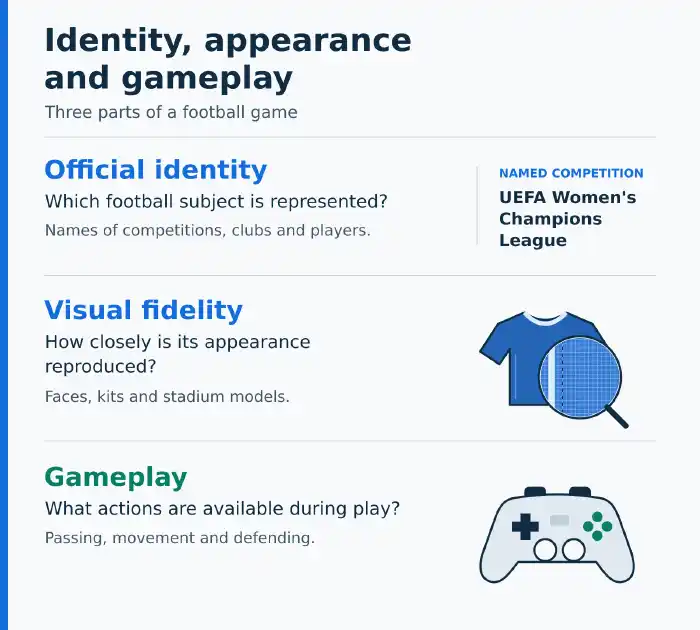
Official identity, visual fidelity, and gameplay therefore need separate descriptions. Identity concerns which football subjects appear. Visual fidelity concerns how closely their appearance is reproduced. Gameplay concerns the actions and interactions available during play. A competition name supplies no description of passing behaviour, and a detailed player model supplies no description of defensive controls.
The distinction also prevents every visible change from being attributed to licensing. A club assignment concerns the football represented in that edition; the detail of a model concerns its depiction. Both sit within the finished game, but calling them the same improvement loses the difference between updating the sporting context and refining its visual form.
Official licences make the game’s connection to particular football identities explicit. Presentation gives those identities a visible form, while the match engine determines the playable experience. The recognisable competition or footballer supplies a reference that survives beyond any single animation: the match belongs to that event, and the on-screen footballer represents that real person.