FC 27 CHEMISTRY STYLES
A Chemistry Style is a consumable item that determines which Attributes can receive boosts from a player’s individual Chemistry.
Ultimate Team Styles
Chemistry Style Items determine which attributes are influenced by chemistry in FC 27. Outfield Chemistry Styles can be applied to outfield Player Items, while goalkeeper styles can only be applied to goalkeepers, allowing you to tailor their attributes to better fit your squad’s needs. They do not change the chemistry rating itself but redirect which stats benefit from the chemistry boost.
FC 27 retains the 3, 6 and 9-point Chemistry Style boost model introduced in FC 26. The exact increase depends on the active style, the individual Attribute and the player’s Chemistry level.
You can apply a Chemistry Style to a player as many times as you like, although only one can be active at once. The effect lasts until a new style is applied. When a player is traded, the active style transfers to the buyer.
There are twenty-four Chemistry Styles in total: nineteen for outfield players and five for goalkeepers. Outfield styles apply only to outfield players, while goalkeeper styles are exclusive to goalkeepers. Special player items, including Heroes, Icons, and loan players, also benefit from Chemistry Styles.
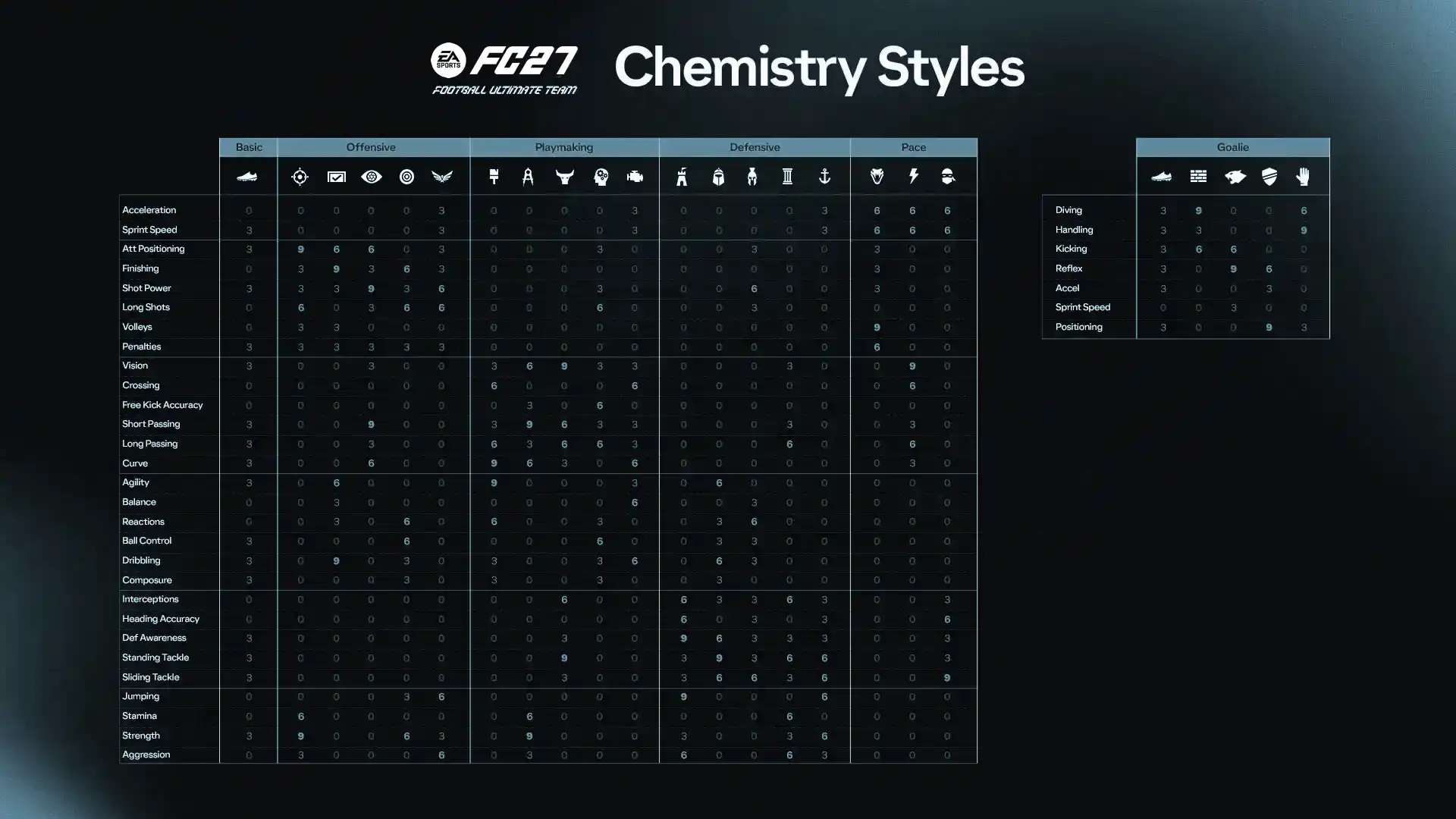
FC 27 Chemistry Styles Changes
No Styles were added or adjusted in FC 27.
| There are no new styles. |

Styles List
Here is the list of all FC 27 Chemistry Styles.
| Style Items | Affected Face Stats |
| GK Basic +1 Diving +1 Handling +1 Kicking +1 Reflexes +1 Speed +1 Positioning |
The default style of every goalkeeper. It gives the same boost to all attributes. It is the right style when you are happy with how stats are distributed. |
| Wall +2 Diving +2 Handling +2 Kicking |
Suitable for those who usually pass back to the goalkeeper or use them to start counterattacks. |
| Shield +2 Kicking +2 Reflexes +2 Speed |
It should only be applied to goalkeepers with specific needs. |
| Cat +2 Reflexes +2 Speed +2 Positioning |
Suitable for keepers with solid control of their box but less ability outside it. |
| Glove +2 Diving +2 Handling +2 Positioning |
Our favorite goalkeeper style. It improves three of the most important goalkeeping attributes. |
| Player Basic +1 Pace +1 Shooting +1 Passing +1 Dribbling +1 Defending +1 Physicality |
The default style of every player. It gives the same boost to all attributes. It is the right style when you are happy with how stats are distributed. |
| Sentinel +3 Defending +3 Physicality |
Suitable for quick defenders and agile CDMs who already have above-average pace. |
| Guardian +3 Dribbling +3 Defending |
A decent option for fullbacks who contribute in both defensive and attacking phases. |
| Gladiator +3 Shooting +3 Defending |
Good for defenders and defensive midfielders who regularly move forward and attempt to score. |
| Backbone +2 Passing +2 Defending +2 Physicality |
Good for CDMs playing in narrow formations and tactical systems. |
| Anchor +2 Pace +2 Defending +2 Physicality |
One of our favorite styles for center-backs. It boosts the three most important attribute categories for the position: pace, defending, and physicality. |
| Shadow +3 Pace +3 Defending |
One of the most expensive styles because it can turn a slower defender into a much more competitive option. |
| Artist +3 Passing +3 Dribbling |
Best for quick midfielders and wingers who are primarily used to cut inside and create chances for strikers. |
| Architect +3 Physicality +3 Passing |
Great for agile wingers. However, it is only truly beneficial if it fits your attacking system. |
| Powerhouse +3 Passing +3 Defending |
Best used on central defensive midfielders or other midfielders with specific defensive needs. |
| Maestro +2 Shooting +2 Passing +2 Dribbling |
Great for players who help build up attacks, but it can also be applied to wingers. |
| Engine +2 Pace +2 Passing +2 Dribbling |
Suitable for attack-minded CAMs, CMs, and wide players. |
| Catalyst +3 Pace +3 Passing |
Suitable for creative players who need more pace. |
| Sniper +3 Shooting +3 Physicality |
A decent option for players who use speedy forwards with average shooting and physical attributes. |
| Deadeye +3 Shooting +3 Passing |
Ideal for solid CFs and attacking CAMs thanks to improvements in Finishing, Positioning, Shot Power, and key Passing attributes. |
| Hawk +2 Pace +2 Shooting +2 Physicality |
One of the most-used styles. It boosts three of the most important attribute categories for a striker. |
| Marksman +2 Shooting +2 Dribbling +2 Physicality |
One of the less popular attacking Chemistry Styles. It is usually applied to fast forwards. |
| Finisher +3 Shooting +3 Dribbling |
Perfect for turning almost everyone into an ST since it boosts the two most important attributes for a player responsible for scoring. |
| Hunter +3 Pace +3 Shooting |
It boosts pace and shooting, the two attribute categories most valued by the community. |

Best Chemistry Styles by Position
When choosing a chemistry style, it is important to consider factors such as price, position, formation, playstyle, squad setup, and player attributes. The following guide lists the top chemistry styles for each position to help you make an informed decision quickly.
Goalkeepers
- Glove
- Basic
- Wall
Center-Backs
- Sentinel
- Anchor
- Shadow
Full-Backs
- Shadow
- Powerhouse
- Guardian
Defensive Midfielders
- Backbone
- Powerhouse
- Shadow
Center Midfielders
- Artist
- Maestro
- Deadeye
Wingers
- Engine
- Catalyst
- Hunter
Strikers
- Finisher (Best Choice)
- Hawk (Runner-Up)
- Hunter (Special Mention)
Frequently Asked Questions
FC 27 chemistry styles are consumable items that allow you to choose which attributes will be affected by the chemistry.
As long as your player has chemistry, the active style will play a key role in their performance. The higher the chemistry, the greater the impact the style will have.
There are twenty-four Chemistry Styles in Football Club: nineteen designed for outfield players and five for goalkeepers. Outfield styles can be applied to any non-goalkeeper, while goalkeeper styles are reserved exclusively for keepers. Remember that these two groups are not interchangeable, as outfield styles cannot be applied to goalkeepers and vice versa.
These items permanently change a player’s Chemistry Style until a different one is applied to him.
Chemistry Styles provide their maximum boosts when the player has three individual Chemistry points. The boosts are reduced at one or two Chemistry points, while a player on zero Chemistry receives no Attribute increase from the active style.
There are three things about FC 27 chemistry styles you can find on a player’s item:
- The name of the style that is active in that player;
- The stats impacted by the style;
- The three diamonds indicating how big is the chemistry.
If you want to use a style in a player, follow these steps:
- From the main Ultimate Team screen, navigate to [Club];
- Select [Squad];
- Choose the Player Item and open [Player Actions];
- Select [Apply Consumable];
- Navigate to the [Chemistry Styles] category;
- Select the desired Chemistry Style and confirm.
FC 27 Chemistry styles, like other consumables, can be used only once. Each player can have only one active style at a time, and the style’s effect lasts until a new one is applied. When you trade a player item, the buyer will receive it with the active style still in place.
Choosing the right chemistry style requires thoughtful consideration of several aspects. While it can be a challenging decision, the best option ultimately depends on your priorities. Below are the main points to keep in mind:
- Price
Chemistry styles vary in cost, typically ranging from 150 to 5,000 coins. Budget-conscious teams should consider this carefully. Keep in mind that higher prices do not always guarantee better results. For instance, Hunter and Shadow are often more expensive, but the Basic style remains a practical and affordable alternative. - Position
A player’s position heavily influences which chemistry style fits best. Defenders benefit from defensive styles such as Sentinel, Guardian, and Anchor. Forwards perform better with attacking styles like Sniper, Deadeye, or Finisher. Midfielders usually suit balanced options like Artist, Powerhouse, or Engine. Goalkeeper styles, naturally, are exclusive to goalkeepers. - Formation
Your team’s formation can affect the ideal chemistry style. Players in identical positions but different formations may require distinct boosts. Central defenders in a 4xx setup might need extra pace, while those in a 5xx formation could focus more on defense and heading. Analyze each player’s tactical role within the formation. - Play Style
Your preferred approach to gameplay should guide your choice. Whether you rely on wide attacks or a more central buildup, ensure the chemistry style complements how you use your players on the pitch. - Squad Composition
Consider how your entire team functions together. If certain strengths are already covered, use chemistry styles to improve weaker areas, maintaining balance and optimizing overall team performance. - Player Attributes
Review each player’s existing stats before applying a chemistry style. Avoid wasting boosts on attributes that are already maxed out (such as 99). Instead, select a style that enhances the player’s strong points and addresses any weaknesses.
One of the most frequent challenges when selecting a chemistry style is deciding whether to balance a player’s weaker stats or further enhance their strongest attributes to make them stand out even more. There isn’t a universal solution to this dilemma.
Generally, players prefer to boost their strongest attributes, as these are often the most important for their role on the pitch. For example, Harry Kane typically focuses on improving his attacking qualities rather than defensive ones, since defending is not a priority for his position.
However, exceptions do exist. When a player’s weaknesses significantly affect their performance, addressing those shortcomings can be more effective. Consider Harry Kane, a powerful striker with outstanding shooting and physical abilities but limited pace. In his case, applying a chemistry style that increases speed may provide a better overall balance than one that further boosts his already strong traits.
In the end, the ideal chemistry style depends on personal preference and the team’s tactical setup. The decision should reflect each player’s role, playing style, and the strategy you aim to implement.
Generally, players prefer to boost their strongest attributes, as these are often the most important for their role on the pitch. For example, Harry Kane typically focuses on improving his attacking qualities rather than defensive ones, since defending is not a priority for his position.
However, exceptions do exist. When a player’s weaknesses significantly affect their performance, addressing those shortcomings can be more effective. Consider Harry Kane, a powerful striker with outstanding shooting and physical abilities but limited pace. In his case, applying a chemistry style that increases speed may provide a better overall balance than one that further boosts his already strong traits.
In the end, the ideal chemistry style depends on personal preference and the team’s tactical setup. The decision should reflect each player’s role, playing style, and the strategy you aim to implement.
0
0
votes
Article Rating
Subscribe
Login
0 Comments
Newest
Oldest
Most Voted
Inline Feedbacks
View all comments